Replace Paper Checks
IT’S 2026
It’s time to stop mailing paper checks.
Paper checks are slow, expensive and operationally complex. There is a better way to send refunds and other payments to your customers.
THE WORLD HAS MOVED ON
Even the U.S. Government is eliminating paper checks.
In 2025, the President of the United States signed Executive Order 14247 directing the Federal Government to transition from paper checks to electronic payments.
Effective September 30, 2025, the Treasury was directed to cease issuing paper checks for most Federal disbursements, including benefits, vendor payments and tax refunds, subject to limited exceptions.
Why? The Executive Order cited unnecessary costs, delays, fraud, lost payments, theft and operational inefficiencies associated with paper-based payments.
16x
Treasury checks historically more likely to be reported lost, stolen, returned or altered

$657M+
Federal spending on physical paper-processing infrastructure in FY2024
4x
Paper check disbursements are more expensive than electronic disbursements
Source: The White House, Executive Order 14247; U.S. Department of the Treasury, Bureau of the Fiscal Service.
Read the Executive Order
ENTERPRISE PROBLEM
So why are businesses still mailing checks to customers?
Paper checks aren’t the preferred choice. They’re the fallback when existing payment systems can’t handle the payment.
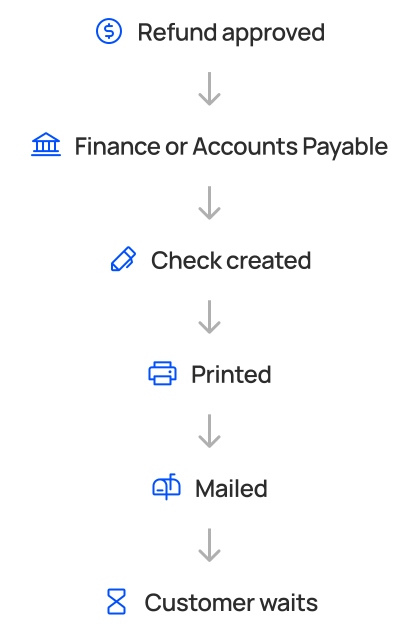
When a refund can’t return to the original payment method, or a customer payment falls outside the standard workflow, businesses often fall back on a process built decades ago.
And when a check is lost, returned, or never arrives, the process starts all over again.
PAPER CHECK VS. TODAYPAY
There’s a better way to pay customers.
Paper Check

Payment delivery
Customer access to funds
Printing
Postage
Mail handling
Lost mail risk
Check reissues
Customer experience
Payment status
Customer payment choice
Manual operations
Reconciliation
Integration
Best suited for
Unclaimed property risk
REPLACE THE FALLBACK
One platform. Every payment that used to become a check.
TodayPay helps enterprises digitize customer payments that historically fall into manual or paper-check workflows.
Refunds
When a refund cannot return to the original payment method, replace the paper-check fallback with a digital refund.
Replace Paper Check Refunds
Reimbursements
Send customer reimbursements digitally instead of routing them through a check workflow.
Digitize Reimbursements
Customer Appeasements
Resolve service issues without creating gift cards, checks or manual payment processes.
Modernize Customer Appeasements
Claims & Resolutions
Digitally resolve approved customer claims without waiting for a check to be created and mailed.
Digitize Claims
Other Consumer Payments
If you’re mailing money to a customer, there’s probably a better way to deliver it.
Talk to TodayPay
THE SHIFT IS ALREADY HAPPENING
Checks are disappearing.
The numbers tell the story. Commercial check usage continues to decline as digital payments become the norm.
4.4B → 2.8B
Commercial checks collected by the Federal Reserve
2019 → 2025
~36% decline
Source: Federal Reserve Board. Commercial checks collected through the Federal Reserve.
The question isn’t whether payments are becoming digital. It’s why your customer payments haven’t.
MEET THE REPLACEMENT
No more paper checks.
Meet TodayPay.
TodayPay is enterprise infrastructure for sending refunds and other payments directly to consumers.
No-code
Start resolving payments through the TodayPay enterprise dashboard without a major technology implementation.
Batch
Replace existing check files with a digital payment workflow.
Integrated
Connect TodayPay directly into your existing customer service, finance, commerce or payment systems.
Instead of printing, mailing and managing paper checks, enterprises can resolve customer payments digitally — with immediate delivery, payment choice and real-time visibility.
See How TodayPay Works
BUILT FOR ENTERPRISE
One problem. Multiple teams paying for it.

Finance
Reduce manual payment operations, check processing and exception handling.

Customer Experience
Replace “your check is in the mail” with a modern digital customer experience.

Customer Service
Give agents and managers a faster way to resolve approved customer payments.

Payments
Extend digital payment infrastructure beyond the original payment method.
FAQs

Are paper checks going away?
Paper checks still exist, but their use continues to decline as businesses, consumers and governments adopt electronic payments. Federal Reserve data show that check payments continue to decline by both number and value. The Federal Government has also moved most Federal disbursements away from paper checks.
Did the U.S. Government eliminate paper checks?
Executive Order 14247 directed the U.S. Treasury to cease issuing paper checks for most Federal disbursements beginning September 30, 2025, subject to limited exceptions. The policy applies to Federal Government payments and does not require private businesses to stop using checks.
Why did the Federal Government phase out paper checks?
The Executive Order cited unnecessary costs, delays, fraud, lost payments, theft and operational inefficiencies. The White House also reported that Treasury checks historically were 16 times more likely than electronic funds transfers to be reported lost or stolen, returned undeliverable or altered.
What are alternatives to paper checks for businesses?
Businesses can replace paper checks with digital payment methods including ACH, payment cards, digital wallets, real-time payments and specialized digital disbursement platforms. The right alternative depends on the payment use case, customer experience and enterprise workflow.
Can businesses replace paper checks for refunds?
Yes. Businesses can use digital refund and disbursement technology to deliver refunds when returning funds to the original payment method is unavailable or impractical. TodayPay provides enterprises with digital infrastructure designed specifically for refunds and other customer payments.
How can a company stop issuing paper checks?
Start by identifying why checks are issued today. Common use cases include refund exceptions, reimbursements, rebates, customer appeasements and other payments that fall outside primary payment systems. These workflows can then be migrated to electronic payment methods or digital disbursement infrastructure.
How much does it cost to issue a paper check?
The total cost varies by organization and includes more than printing and postage. Businesses should consider check production, employee handling, approval workflows, mailing, reconciliation, customer support, lost checks, stop payments and reissues when calculating the true cost.
Are digital payments faster than paper checks?
Generally, yes. Paper checks require printing, mailing, delivery, deposit and bank processing. Digital payment methods can eliminate many of these steps and provide customers with substantially faster access to funds.
Does the Federal paper-check Executive Order apply to private companies?
No. Executive Order 14247 applies to Federal Government payments. Private businesses are not required by the Executive Order to eliminate paper checks. However, many of the reasons cited by the Federal Government — cost, delays, fraud risk and operational inefficiency — also apply to commercial check workflows.
What is TodayPay?
TodayPay provides enterprise infrastructure for digitally resolving refunds and other customer payments. Businesses can use TodayPay to replace legacy processes such as paper checks through no-code tools, batch processing or integrated workflows.

About this resource
The resource for businesses replacing paper checks with modern digital payments.
NoMorePaperChecks.com is an educational resource published by TodayPay. References to U.S. Government policies are provided for informational purposes only and do not imply endorsement of TodayPay by any government agency.
